Showing posts with label Gender. Show all posts

Monday, 18 November 2013

The problem with Feminist language


I feel that the biggest problem holding back a more effective discussion about gender equality is a problem of language.  What is alienating about the feminist movement is the use of somewhat exclusionary language.  I think in order to reach a broader spectrum of people, language must be carefully used when hashing out the important issues.

When driving any kind of revolution forward, I think it’s natural to create an ingroup.  This ingroup will automatically empathize with its own members.  This causes a kind of doublespeak in some internal dialogues.  Out of convenience, these movements will create their own words to describe certain concepts.   Like any kind of political party, nationality or ideology, it’s members know more about the “real” issues than outsiders.  Projecting an image of ignorance and incredulity on the outsiders of the movement.  

I’ve been a part of many of these ingroups which create their own mini-languages to explain the paradigm they’re attempting to overthrow.  Its very easy to sink into a closed off intellectual bubble, where only those who are inside can understand what you are talking about.  This becomes problematic when you attempt to relay these concepts to outsiders.  This is especially problematic if your bubble is intent on overturning the current system and replacing with their own way.  

It can be most easily seen in religious movements.  its very hard for religious to address the outside world if they’re so enveloped in the language of their tradition.  Words and phrases like “redemption”, “fear of God’ and “sinner” probably have a much different meaning to those who hear them outside of their religious contexts.  This can only alienate and confuse those well-intentioned outsiders.

This unfortunately, I feel is true about the feminist movement.  Any kind of group with an “ism” at the end of their name is going to encounter alienation problems.  While the ideas behind the movement are by and large good, they present an unpleasant and alien image to the outside.  The feminist movement is appealing to those who are already alienated from the male-dominated culture.  It’s language is appealing to those who have found alienation and emptiness in gender identities.  But it’s true intention is to change the culture.  It’s not going to be attractive to those still fully connected to the gender system who in fact need feminism the most.  

The first language problem I think stops most people is the use of the word “Feminism”.  “ism” is a sure sign of a political ideology.  The root, “feminine” denotes the inclusion of the female sex as the biggest component.  The word by itself is exclusionary to anything masculine.  If someone sympathizes with feminism as a man, they often must caveat their identity with “male-feminist”.  I believe that the true ideals of “feminism” would not need anyone to declare their gender identity.  

I think the word “feminism” is creating a problem that is counterproductive to it’s own cause.  Because of its name, it’s creating an ingroup of people, simply based on a single sex or a gender. Naturally It will gather together people who are alienated and angry at the gendered system we live in.  

Its a stereotype and an oversimplification of feminists that they are “angry at men”.  For the most part, I agree that its just a stereotype.  But even the most offensive stereotypes have their origins in some kind of small truth. To illustrate this point, I would compare this to people calling atheists “angry at God”.  While the atheist would say that they don’t even believe in God’s existence.  The theist may not properly comprehend the very idea of a godless world.  They can’t truly understand the mentality of an atheist.  So, to them it looks as if the atheist is behaving like a rebellious teenager against a parent.

When someone says “Feminists are just angry and hate men.”  That person is probably well situated deep inside the gendered system.  To an outsider, all they see is a group of upset women.  Since this person takes the notion of “men and women” for granted, who else can feminists be possibly angry at?  They are like the theist who doesn’t understand the mindset of a person without a belief in God.  The outsider to feminism doesn’t understand that the whole dichotomous gender system is what is being targeted, not men.  They can’t understand a world without gender as a personal identity.  Gender is such an important part of their world, its very hard to see these issues without it.  The word “feminist” enforces that mentality with its inherent dichotomy of feminine versus masculine.        

Are there feminists who do actually just hate men? Sure, I wouldn’t bet against it.  But they’re no different than those men who hate women.  I would say that these people have legitimate complaints about their gender and its relationship to the “opposite”.  But this negative energy is just missdirected.  Without recognizing the real source of their issues.     
       
I should expand this to all kinds of movements that are attempting to change gender and sexuality in our culture.  I truly believe these groups are trying to change the world for the better.  But the way they’re presented to the world is often in an unfavorable light.  Its often because of the language used.    

Words like “patriarchy”, “hegemonic masculinity”, “CISgender” “rape-culture”, “male privilege” have a way of unconsciously talking down to those who don’t know their meaning.  How many letters have to be added to the LGBTQ..(?) abbreviation to be politically correct?  Is it offensive to call someone “transvestite?”, “transexual?”, “transgendered?”.  It feels like if I don’t know the correct term, I’m a bigot.  It’s these sorts of concepts only privy to insiders have an alienating effect to those outside.

The word “rape-culture” is one such example of a topic worth addressing that is alienating to those who don’t know what it is.  When I first encountered the concept of rape-culture, it was in a dialogue in a university newspaper. I found the term to be unnecessarily aggressive and shrill.  Whoever was arguing against rape-culture, the writing seemed to be coming from a place of high emotion.  I can totally understand why.  But keep in mind, that kind of passion will be alienating to men who’ve never heard of it.  I was one of those men.  I didn’t know what it was, but the article certainly didn’t win me over.  From then on I associated that term with an air of confrontational feminism, which I had no desire becoming a part of.  As a man, “rape-culture” made me feel guilty by association.  I’m the one of most timid guys you’ll ever meet.  I felt I would never do anything to enable that kind of behaviour.  All it did was make me even more confused than I already was about how to behave around women I was attracted to.  

Keep in mind, I’m not trying to discredit any of the facts about rape culture.  I’m just trying to point out how the concept isn’t the most endearing to those uneducated.  Many men are probably now feeling the same way I used to about “rape-culture”.  

 It wasn’t until I took a sociology of gender course, that I began to really understand these issues.  It took maturing and self examination to see feminism as a good thing.  But it took a process of becoming fluent in feminist language to fully grasp what the intent was.  To be clear, I’m not proposing any kind of alternative to the words we use.  I wouldn’t know where to start.  I’m just trying to illustrate some of the unintended problems that naturally occur in social movements and language.       

Wednesday, 23 October 2013

So, I wore a woman's purse

For my sociology of gender course, we had to do something that would subvert our gender in some way. So I decided to wear a woman's purse to school for a few days. I thought I knew what I was getting into, but the experience was more overwhelming than I had expected.

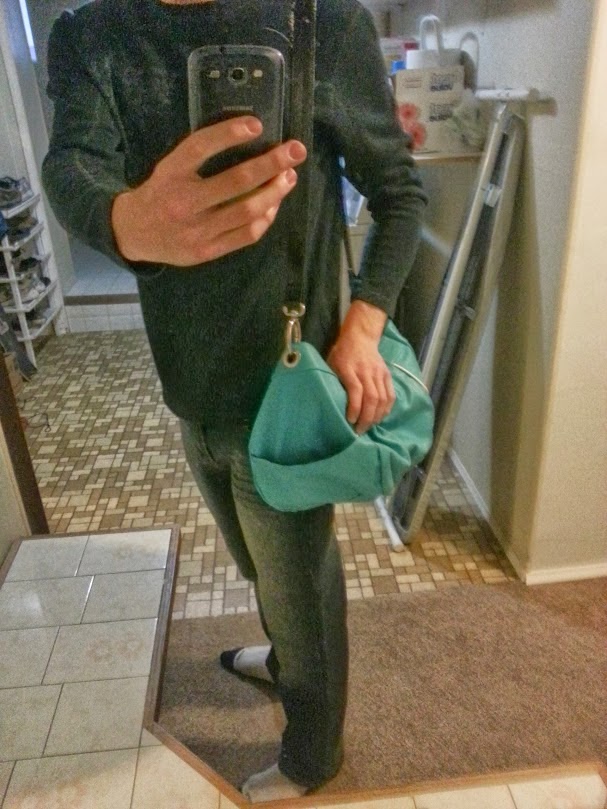
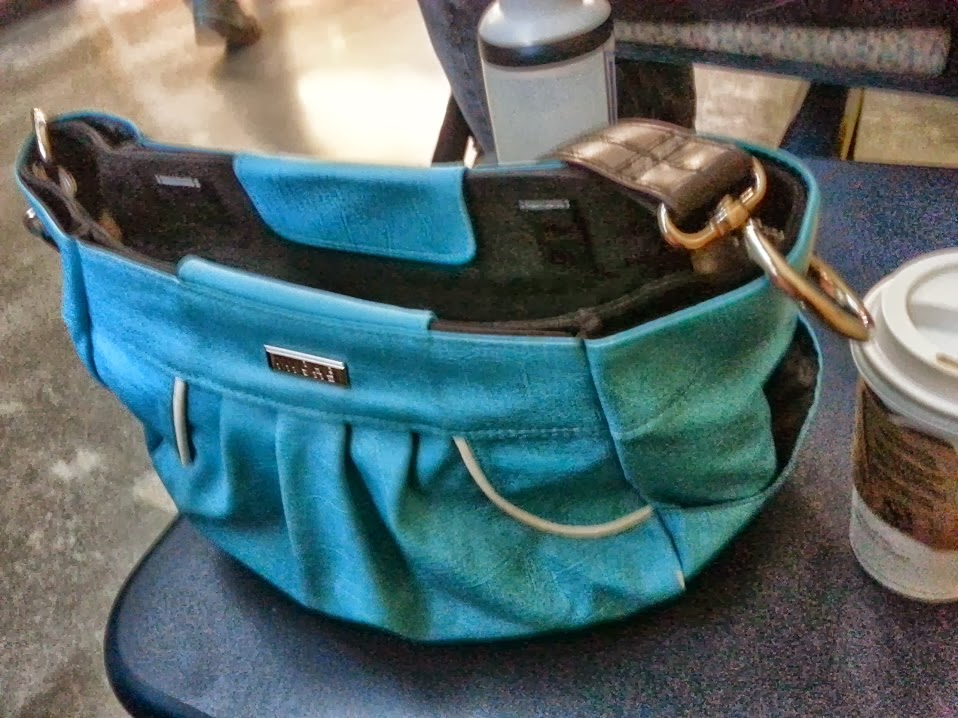
First of all, I want to look at what makes a particular bag a “woman’s purse”.  It apparently is a very subtle difference that genders the object.  The bag that I chose is a turquoise in colour and is leathery.  It has a thin black leather strap with large ornamental metallic rings connecting to the bag.  It’s soft to the touch and the shape is malleable.  The difference is small, but definitely noticeable.  My subversion experience gave me a keen eye for what other people were wearing as well.  A few people I noticed were obviously subverting gender with their bags because they were transgendered.  But there were no other "cisgendered" men wearing women’s bags  A man will wear a bag if it doesn't call attention to itself.  It will usually be dark coloured.  Black, brown, blue, green and red are usually found on men.  The kind of bag that is appropriate for a man to wear is much more modest.  If a man does wear a purse, he might call it a “Man purse” or a satchel.  Very specifically named to indicate that it is not a woman’s purse.  What is most important to note is that men’s bags are gender neutral.  It wouldn't be a diversion or subversion of gender for a woman to wear a bag that is also appropriate for a man to wear.  A modestly coloured backpack, shoulderbag, duffel bag, suitcase would be totally normal for a woman to wear.  There doesn’t seem to be a social restriction on what kind of bag a woman can carry.            

My experience with gender subversion began when I actually purchased the bag.  The university book store was selling some miscellaneous used objects on a clearance table.  I had to gather up some courage to pick up the bag and bring it to the cashier.  I placed the bag in front of her, handed her two dollars and said “don’t ask”.  She responded with “hey I don’t judge”.  Its interesting that I felt like I had to explain myself for why, as a young man I was purchasing such an unusual object.  Another woman who was also present, jokingly remarked, “Its beautiful. It matches your eyes.”

A few days days later, I decided to bring it to school as my means of carrying my stuff instead of my usual backpack.  I wrote my name in big letters with a black sharpie on the bag just to aleve my fears that people would think that I stole some woman’s bag.  I decided that I would I use my purse to carry my wallet and cell phone.  I typically carry both of them in my pockets but I think that women usually carry these things in their purse.  This way I would have to carry the purse wherever I went.  It would give me the full purse experience.  I haven’t experienced being this uncomfortable in public in a very long time. Not since being an insecure junior high school kid have I felt so visually awkward and out of place.  As I approached the school on my bicycle, I was petrified as I passed some of the other students.  I wasn’t sure if they noticed my purse or not, but what mattered was how I felt. When I got the school, I tried keeping the purse out of sight as I ate breakfast.  I think I’ve observed a few people giving me odd looks as I walked pass them with the purse in full view.  I smiled at people a lot more than I usually do.  The kind of smile you have when you’ve been thinking of something funny.  Maybe because I was trying to unconsciously tell everyone who saw me that this odd situation seemed very silly to me as well.  Right now I’m writing this paper at a school computer, its nearly 3 pm and I’m hungry for lunch.  But I’m too embarrassed to walk up to the food court and get something to eat.

I ran into a female friend of mine at the end of the first day with the purse.  We talked about various small talk things including what I was doing with the purse.  What I found interesting was that she said she wouldn't have noticed anything unusual about my bag if I hadn’t brought it to her attention.  If I may be rudely judgmental for a moment, I’d have to say that I consider this particular friend of mine more of a girly girl(bleached blonde hair and lots of pink).  If she didn’t notice anything odd about me, why would the rest of the university?  The university is probably the most “progressive” and non judgmental place in Lethbridge, so why would people be constantly judging me as if I were in high school?   This made me think that I was making a bigger deal about carrying a woman’s bag than was necessary.  This may have been a sign that this gender subversion project was telling me more about my autobiographical identity, rather than how the rest of the people in my world see me.  Maybe it was just pointing out another instance of insecurity of my own failure to live up to this culture’s image of masculinity.  Previously I thought of myself as someone who didn’t care about being thought of as sub-masculine.  I’m never the most physically imposing person.  I don’t exhibit many overtly masculine qualities.  I didn’t think I cared too much about by place on the gender scale.  But this experiment showed me that I really am concerned about my own place in this gendered culture.  

Why are the bags we carry so important to our gender identity?  Could it be about body image?  Is it about the different kinds of gender specific objects we carry?  I think its a combination of several things.  I think what may look like an arbitrary difference in bags, is more a result of other cultured gender differences.  When I wore the purse, I used it to carry the things I usually carry in my jeans pockets.  Keeping things in their jeans pockets is the usual place men carry their everyday objects like a cell phone or a wallet.    But its very rare to see a woman carry a large object, like a wallet in her back pocket.  Well, a close look at pants fashion will give a possible clue to why this is.

Women’s pants tend to be much tighter fitting than men’s pants.  So carrying a wallet in her jeans would be uncomfortable perhaps.  But maybe more importantly, her figure would be undesirably distorted.  The purpose of her tight fitting jeans in the first place was to reveal the attractive shape of her backside.  It would then make more sense that she keep her pants clear of any object that would change her shape.  I found out that this intention is even more blatant than I thought.  In discussion with one of the female class members, I discovered that many styles of women’s jeans have impractically small pockets, making it virtually impossible to carry large objects anyway.  Men’s pants are relatively more loose fitting than women’s and have larger pockets.  This could be an example that the apparent shape of his butt is not much a concern to his body image or his masculinity.                  

Since I spend most of my time at the university, I see that men and women both carry relatively the same amount of stuff.  But in the real world, a woman may carry a bag because of a perceived need to bring more things with her.  On a daily round of errands, say a day shopping around town, the average man will not likely bring more than whatever he can fit into his pockets.  But you might expect a woman to bring her purse with her in the same scenario.  Why is this?  I cannot say for sure, but I can speculate.      


 A very interesting thing I noticed was the difference in the way I held the purse made.  If I put the shoulder strap across my chest onto the opposing shoulder, it felt a little more appropriate.  Hanging the bag on the shoulder of the same side made me feel more uncomfortable.  The way a woman carries her bag also has an effect on her body image, this could be a reason why strap positions I experienced, felt gendered.  A woman will usually wear a shirt that will reveal the shape of her breasts.  A purse strap that crosses her chest, will awkwardly obstruct her breasts if she is wearing a revealing shirt.  In order to preserve her body image, the purse will be held on the same shoulder.     

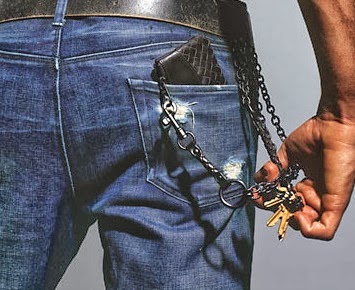
A deeper and more speculative reason for gendered bags may have to do with men and women’s difference in mentality.  Men are expected to be more dominant and possessive.  Men are expected to be more independent and personally responsible for the things we own.  We keep our wallet and cell phone very close to our body to make sure we are always in possession of it.  We can constantly feel them against our bodies.  Throughout the day, I habitually touch my wallet in my back pocket, just to comfort myself.  In fact, some men wear chains on their wallets just to be safe.  This was another odd feeling I noticed when I carried the purse.  I had to double check for my important things inside the purse throughout the day, just to make myself feel better.  Frankly I feel naked if I don’t feel the bulge of my wallet in my back pocket.  It would take a lot of time for me to get used to the state of mind of letting go of these personal objects.  

in our culture, women are often thought to be more passive and docile.  They’re not expected to be as owning and controlling as men.  The idea of a gendered bag reflects this attitude of feminine passivity.  The purse puts more distance between the object and the owner.  The woman is not as intimately connected with the objects she possesses.  Its a subtle but noticeable difference in my own experience.  Another fact that makes the purse representative of feminine domestication is how susceptible to theft it is.  A woman has less of a physical connection to her valuables   The purse is a more exposed object at risk to be stolen then say, a (chained) wallet.  It illustrates how women are viewed as defenseless in the face of adversity, requiring a man to be responsible for her.  Of course this is all conjecture, but I thought it was an interesting idea anyway.