Wednesday, 23 October 2013

So, I wore a woman's purse

For my sociology of gender course, we had to do something that would subvert our gender in some way. So I decided to wear a woman's purse to school for a few days. I thought I knew what I was getting into, but the experience was more overwhelming than I had expected.

First of all, I want to look at what makes a particular bag a “woman’s purse”.  It apparently is a very subtle difference that genders the object.  The bag that I chose is a turquoise in colour and is leathery.  It has a thin black leather strap with large ornamental metallic rings connecting to the bag.  It’s soft to the touch and the shape is malleable.  The difference is small, but definitely noticeable.  My subversion experience gave me a keen eye for what other people were wearing as well.  A few people I noticed were obviously subverting gender with their bags because they were transgendered.  But there were no other "cisgendered" men wearing women’s bags  A man will wear a bag if it doesn't call attention to itself.  It will usually be dark coloured.  Black, brown, blue, green and red are usually found on men.  The kind of bag that is appropriate for a man to wear is much more modest.  If a man does wear a purse, he might call it a “Man purse” or a satchel.  Very specifically named to indicate that it is not a woman’s purse.  What is most important to note is that men’s bags are gender neutral.  It wouldn't be a diversion or subversion of gender for a woman to wear a bag that is also appropriate for a man to wear.  A modestly coloured backpack, shoulderbag, duffel bag, suitcase would be totally normal for a woman to wear.  There doesn’t seem to be a social restriction on what kind of bag a woman can carry.            

My experience with gender subversion began when I actually purchased the bag.  The university book store was selling some miscellaneous used objects on a clearance table.  I had to gather up some courage to pick up the bag and bring it to the cashier.  I placed the bag in front of her, handed her two dollars and said “don’t ask”.  She responded with “hey I don’t judge”.  Its interesting that I felt like I had to explain myself for why, as a young man I was purchasing such an unusual object.  Another woman who was also present, jokingly remarked, “Its beautiful. It matches your eyes.”

A few days days later, I decided to bring it to school as my means of carrying my stuff instead of my usual backpack.  I wrote my name in big letters with a black sharpie on the bag just to aleve my fears that people would think that I stole some woman’s bag.  I decided that I would I use my purse to carry my wallet and cell phone.  I typically carry both of them in my pockets but I think that women usually carry these things in their purse.  This way I would have to carry the purse wherever I went.  It would give me the full purse experience.  I haven’t experienced being this uncomfortable in public in a very long time. Not since being an insecure junior high school kid have I felt so visually awkward and out of place.  As I approached the school on my bicycle, I was petrified as I passed some of the other students.  I wasn’t sure if they noticed my purse or not, but what mattered was how I felt. When I got the school, I tried keeping the purse out of sight as I ate breakfast.  I think I’ve observed a few people giving me odd looks as I walked pass them with the purse in full view.  I smiled at people a lot more than I usually do.  The kind of smile you have when you’ve been thinking of something funny.  Maybe because I was trying to unconsciously tell everyone who saw me that this odd situation seemed very silly to me as well.  Right now I’m writing this paper at a school computer, its nearly 3 pm and I’m hungry for lunch.  But I’m too embarrassed to walk up to the food court and get something to eat.

I ran into a female friend of mine at the end of the first day with the purse.  We talked about various small talk things including what I was doing with the purse.  What I found interesting was that she said she wouldn't have noticed anything unusual about my bag if I hadn’t brought it to her attention.  If I may be rudely judgmental for a moment, I’d have to say that I consider this particular friend of mine more of a girly girl(bleached blonde hair and lots of pink).  If she didn’t notice anything odd about me, why would the rest of the university?  The university is probably the most “progressive” and non judgmental place in Lethbridge, so why would people be constantly judging me as if I were in high school?   This made me think that I was making a bigger deal about carrying a woman’s bag than was necessary.  This may have been a sign that this gender subversion project was telling me more about my autobiographical identity, rather than how the rest of the people in my world see me.  Maybe it was just pointing out another instance of insecurity of my own failure to live up to this culture’s image of masculinity.  Previously I thought of myself as someone who didn’t care about being thought of as sub-masculine.  I’m never the most physically imposing person.  I don’t exhibit many overtly masculine qualities.  I didn’t think I cared too much about by place on the gender scale.  But this experiment showed me that I really am concerned about my own place in this gendered culture.  

Why are the bags we carry so important to our gender identity?  Could it be about body image?  Is it about the different kinds of gender specific objects we carry?  I think its a combination of several things.  I think what may look like an arbitrary difference in bags, is more a result of other cultured gender differences.  When I wore the purse, I used it to carry the things I usually carry in my jeans pockets.  Keeping things in their jeans pockets is the usual place men carry their everyday objects like a cell phone or a wallet.    But its very rare to see a woman carry a large object, like a wallet in her back pocket.  Well, a close look at pants fashion will give a possible clue to why this is.

Women’s pants tend to be much tighter fitting than men’s pants.  So carrying a wallet in her jeans would be uncomfortable perhaps.  But maybe more importantly, her figure would be undesirably distorted.  The purpose of her tight fitting jeans in the first place was to reveal the attractive shape of her backside.  It would then make more sense that she keep her pants clear of any object that would change her shape.  I found out that this intention is even more blatant than I thought.  In discussion with one of the female class members, I discovered that many styles of women’s jeans have impractically small pockets, making it virtually impossible to carry large objects anyway.  Men’s pants are relatively more loose fitting than women’s and have larger pockets.  This could be an example that the apparent shape of his butt is not much a concern to his body image or his masculinity.                  

Since I spend most of my time at the university, I see that men and women both carry relatively the same amount of stuff.  But in the real world, a woman may carry a bag because of a perceived need to bring more things with her.  On a daily round of errands, say a day shopping around town, the average man will not likely bring more than whatever he can fit into his pockets.  But you might expect a woman to bring her purse with her in the same scenario.  Why is this?  I cannot say for sure, but I can speculate.      


 A very interesting thing I noticed was the difference in the way I held the purse made.  If I put the shoulder strap across my chest onto the opposing shoulder, it felt a little more appropriate.  Hanging the bag on the shoulder of the same side made me feel more uncomfortable.  The way a woman carries her bag also has an effect on her body image, this could be a reason why strap positions I experienced, felt gendered.  A woman will usually wear a shirt that will reveal the shape of her breasts.  A purse strap that crosses her chest, will awkwardly obstruct her breasts if she is wearing a revealing shirt.  In order to preserve her body image, the purse will be held on the same shoulder.     

A deeper and more speculative reason for gendered bags may have to do with men and women’s difference in mentality.  Men are expected to be more dominant and possessive.  Men are expected to be more independent and personally responsible for the things we own.  We keep our wallet and cell phone very close to our body to make sure we are always in possession of it.  We can constantly feel them against our bodies.  Throughout the day, I habitually touch my wallet in my back pocket, just to comfort myself.  In fact, some men wear chains on their wallets just to be safe.  This was another odd feeling I noticed when I carried the purse.  I had to double check for my important things inside the purse throughout the day, just to make myself feel better.  Frankly I feel naked if I don’t feel the bulge of my wallet in my back pocket.  It would take a lot of time for me to get used to the state of mind of letting go of these personal objects.  
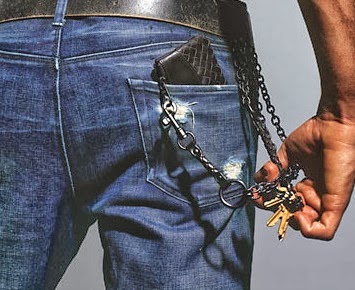
in our culture, women are often thought to be more passive and docile.  They’re not expected to be as owning and controlling as men.  The idea of a gendered bag reflects this attitude of feminine passivity.  The purse puts more distance between the object and the owner.  The woman is not as intimately connected with the objects she possesses.  Its a subtle but noticeable difference in my own experience.  Another fact that makes the purse representative of feminine domestication is how susceptible to theft it is.  A woman has less of a physical connection to her valuables   The purse is a more exposed object at risk to be stolen then say, a (chained) wallet.  It illustrates how women are viewed as defenseless in the face of adversity, requiring a man to be responsible for her.  Of course this is all conjecture, but I thought it was an interesting idea anyway.    

Wednesday, 2 October 2013

The future of art in the age of the Internet

Is there a living to be made in the future as a musician?   Some of my more musically inclined friends are currently facing this dilemma.  How can the average up and coming musician expect to make enough money to sustain themselves while pursuing their artistic passion?  The internet has created an environment where no one has to pay for any music if they choose not to.  I can empathize with their struggles.  But like everyone else I also take advantage of the convenience that so-called “piracy” gives us.  I’m not particularly opinionated either way.  On one hand I can see that the internet is breaking down so many barriers, some we didn't even know existed.  I see the widespread distribution of all information as a very good thing.  But I’m also aware that people need to be able to feed themselves and pay rent.    

The attitude for creation

lately I’ve been an evangelical preacher about pursuing what you are passionate about.  To a point where it may be irritating for those around me.  If you find something you are passionate about and have the freedom to pursue it, I believe you have to dedicate your life to that pursuit.  If you think you don’t have a passion, I believe you must drop everything in order to discover that passion.  At a certain level, pursuing a passion requires great sacrifice.  You may not be able to support a spouse or family.  You may not be able to dedicate yourself to school or higher education.  You may have to live in poverty.  But you can’t have your cake and eat it too. If you’re an aspiring artist, realize that you will have to give up many things to become a master.  But it should feel like a duty to give yourself to the higher cause of art.  If you really believe you are an artist or creator, it shouldn't feel like a choice to pursue it.  I think this attitude is going to be crucially important as we move into the internet age

The cult of personality.  

We live in a society where we worship musicians.  I obsess over and idolize many bands.  Hell, I even got a Iron Maiden logo tattooed on my leg when I was 20.  When someone gets to that kind of immortal status as an artist, it’s no longer just about the art.  The art becomes secondary to the person who created it.  You become more like a prophet or mythical figure.  If the band Rush releases anything new, I eat it up like candy.  I’m almost unable to recognize it’s true artistic value objectively.  When we get into the same livelihood as those we idolize, we work with the far-fetched distant fantasy in the back our minds where that kind of success is possible.  A fantasy though it is, we still realistically expect to be recognized individually for the art we create.  Because we have a sense of “owning” that which we create.  This ego driven desire, causes a need to be personally recognized for the art we create. When someone appreciates our art, we want to be known as the person who created it.  

The problem with the music “industry”

Perhaps the environment that produced a “music industry” in the first place was itself, unbalanced.  The music scene of the past century has been of an ego-driven and fame based nature.  Because of its democratic nature, the internet is now just revealing the true value of the art.  Maybe the internet is just revealing the realistic expectations we should have about artistic pursuits.     

The concept of owning art doesn't exactly jive with my sense of fairness.  Music as a commodity doesn't make sense to me.  If a piece of music can be recorded and replicated infinite times, what are you selling exactly?  Certainly its not a scarce resource.  From my understanding of economics, I think at the most basic level, there is no way that information like music can be “sold”.  The only reason there ever was a market for music is because of the method that music used to be delivered.  Either by radio or solid media like tapes, CDs or vinyl were the only way you could hear music.  It cost manufacturers and radio stations to distribute this music.  So the only commodity that was actually being sold were the time and services of those with the platform on which to distribute it.  This is probably how we ended up with an over inflated value on popular music and a small population of millionaire musicians.  But the internet has now destroyed any kind of scarcity of distribution to speak of.  How now shall we determine the monetary value of music?   

Plus, the skill it requires to produce music is decreasing.  I’m afraid to insult any electronic music fans here but, I doubt it requires as much effort to create a Deadmau5 album than a Van Halen record.  There aren't many actual instruments being played in dubstep or techno.  Should the effort it took to create a piece of art equal the cost to buy it? There are many unanswerable questions when it comes to knowing how to pay musicians.

The only option moving forward is voluntary donation directly to the artists.  I really don’t see many other ways. But I’m trying to be optimistic about the future, I’m not discounting the unseen possibilities.

Music as the exception

Why does the music industry seem like its the only victim of this market shift? I think nearly all forms of art are going to be affected by the gargantuan presence of the internet.  If not directly affecting the platform to distribute it, its changing people’s attitudes towards art.  The necessity to purchase the results of creativity is no longer there.  We don’t feel obligated to pay for anything creative anymore. I don’t know, but perhaps thats the way things should be.  This keeps the artists free from any financial motivations that may taint the pure passion of their art.  We’ve all heard the story of the once great musician, comedian or actor who “sells out”.     

Here I am, publishing blogs for the world to read without any need for a magazine, newspaper or journal.  Granted it’s a very small audience at the moment, but it doesn't stop me from writing passionately about the things I care about.  I write to hone my craft.  I write because I feel like I have to.

My blogs aren't my “intellectual property” to sell.  It would be ridiculous to expect to be paid with money every time someone read my blog.  I’m just ecstatic that one person took time out of their day to read what I have to say.  My blogs are my own exercises in writing.  They are a growing and (hopefully) improving collective body of unique work on which I try to build an honest intellectual reputation.        

In regards to the music “industry” this may be a helpful attitude for up-and-comers.  Things aren’t going to be like they used to.  But I think there is a place in the world for every passionate individual with a little talent.  Don’t ever expect to get financially compensated for what you do, just be excited someone wants to hear your stuff.  Just keep putting all your passion and effort into this and maybe one day you’ll get what you feel you deserve.    

Wednesday, 25 September 2013

The Myth of Memory

In modern times we have a distinct conception of the past.  Two kinds of the past exist in our heads.  We have a version of the past we think of as absolute fact.  This is what we call “History”.  We treat history as all we need to understand humanity and its place in the world.  History is the truth, or at least the pursuit of past truth.  History is the documented version of the past as it happened.  Documented evidence and first hand witnesses are used to to write the history of the world as it truly was.

The second kind of past is myth.  Myth is a version of the past we have extensively marginalized in modern life.  If a sketchy story of the past is told to us, we often disregard it with the phrase, “Oh thats just a myth.”
If we are told about the stories of Sasquatch living in the Pacific Northwest, we may scoff at it and roll our eyes.  To the modern thinker any narrative of the world without evidence is of no use to us.  Without a body of Bigfoot, what good is talking about him doing?  We hate myths because they don’t bring us any documentation we can canonize the history of the world with.  As modern, rational, scientific thinkers we have no time for silly stories that are simply untrue.  We bravely march into the future and discard all the stories that don’t provide us with any hard testable evidence.  By removing all meaning or purpose to the past, we can discover it’s true nature.  But we don’t give as much thought to what myth can tell us about the nature of human beings .
Fact? Fiction? or does it matter?

I think that we misunderstand the purpose of myth.  We think of myth as just a primitive version of history.  I think myth is telling us much more than just what happened in the past.  Myth tells us about how humans view the world around them.  They are stories of the way other cultures view existence.  Myths are how cultures tell their stories of why the world is the way it is.  They characterize our collective fears and aspirations into clean and easy narratives.  History is way too complicated and messy to extract any kind of story worth paying attention to.       

I’m going to outline a rather radical idea I’ve come up with.  I think most of what we think of “history” more closely resembles myth.  Not only that but I think our personal memories of our lives are more like myths rather than truths.  I want to argue that we need to change the way we think about our own lives.  In order to evolve and progress as individuals and as a civilization, we need to outline a more mythical version of our past.      

One of my favorite Youtube channels, Idea Channel outlined an example of history that is more like myth.  The historical Nikola Tesla is not really the man with all his personality and characteristics but a retold version of him created by culture.  History creates a simulated version of everything.  It takes the important parts of the past and compacts it into what we need to know.  Like a myth, history is the version of the past that tells the story of why the world is the way it is.  


This is one of the reasons I find religion so incredibly perplexing.  Why are Christian fundamentalists so insistent about knowing what Jesus actually said?  Why does it matter that Jesus was truly the son of God?  Why does the crucifiction have to be a factual event?  What matters is the meaning people take out of or read into the Jesus story.  The story has been translated and retold so many times by fallible humans to create a cohesive narrative that it is truly absurd to think that these are facts.  Don’t use the bible as a historical document.  Take lessons from it like every other great myth told.
     

The Myth of your life

I recently watched a film called Dark City for my Religious Studies and Science Fiction class.  One of the features in the movie that interested me was the the idea of memory manipulation.  The humans had their memories changed and manipulated by a race of higher beings.  They would experiment with humans and change personal identities by swapping memories with other humans.  People would live their lives thinking that everything was normal but in reality, their identities had been repeatedly rewritten.    

It made me think about how we take our own memories as unchanging truth even though they are so easily changeable.  That “historical” truth becomes the bedrock of our personal identity.  We treat our memories as if they were photographic records of past events.  We pretend that we are walking video cameras that document the world as time passes by the second.  When in reality we are incredibly subjective and selective with our memories.  Memories are re-formed over and over again.  Until they are no longer factual truth. 

If you have been alive for some time, you may have had the experience of sharing a distant memory of an event with an old friend and come to the realization that they way you remember it resembles nothing of your friend’s version of it.  In any given event of our lives, we’ll tell our own version of what happened, but it will be a totally unique version of the event.  What this fact should tell us is that memory should be thought of as not historical truth, but as myths with meaning. Our own memories take the important parts of our lives and add significance to them.  It removes the boring details of moment to moment experience and adds story structure and plot.  Yet we define ourselves by these fractured and colourized versions of the past.  

Many of us are memory fundamentalists.  We treat our memories like they were written in stone facts about the past.  Our memories become the written history of ourselves and we identify with that past.  This is reinforced by the fact that you are incredibly judged by other people’s memory of you.   If you have done bad things in your past, then you are defined by those bad things.  No matter how much you have changed.  No matter how much you desire to move on with your life, you are a bad person because you ARE your past.  If you’ve been to prison, then you’ll always be a convict in the eyes of others.  We define others around us by the past as we remember it.  We hold grudges against people we should probably forgive and cling on to illusions of people that we should let go of.  

I believe the theory of the mythic memory is a great strategy to empower yourself.  By distancing yourself from your past, you don’t have to be held back by it.   Instead of being defined by your past, use it as a story to learn from.  Every instance you’ve fucked up is no longer a stain to be ashamed of.  Those instances are now examples of what not to do in the future.  Your past life is now a story to tell the world. No matter how insignificant you think you are, I believe you have a story worth sharing.  Start narrating your life as if you were the author writing the novel, The Adventures of (your name here).  Think of your life as a movie and you are the playing the hero.  Your life is no longer a historical document but an epic tale of how you turned your life around by overcoming whatever shortcomings you were perceived to have, and decided to live the life you always dreamed of having.      
    

Thursday, 5 September 2013

Dancing with a ghost


Exploring Indian Reality
Rupert Ross, 1992

I want to do a little bit of a book review of a book my mother turned me on to.  My mom seldom reads non-fiction books.  So when she told me she was really enjoying reading this particular book I was intrigued.  The way she was explaining the book to me this summer, it sounded like the kinds of ideas I had been thinking about a lot lately.  I kind of blew my mind.  The book is an attempt to explain to the non-native, Canadian majority, the fundamentals of the workings of aboriginal culture.  It’s an attempt to bridge the apparent gap between two cultures.  Written from the point of view of a white lawyer from Ontario, it’s a personal account in dealing with aboriginal culture in the justice system.  Rupert Ross tries to deal with disconnections in the cultural intercourse that ends up leaving both parties in confusion.  This book was written more than 20 years ago, but I feel this is still a relevant book with a topic essential to be understood by all people wishing to understand aboriginal issues
Right off the bat I would like to acknowledge my clear ignorance of the issue at hand.  In fact I feel slightly uncomfortable talking about this issue because I feel like I am stumbling around in the dark.  I am blind to know what should be obvious to me, what sensitive issues I may want to avoid.  I hope in admitting my humble amount of knowledge, I can hopefully be forgiven for any sensitive trespasses I may cause in my writing.   I’m ignorant to even what words I should be using to refer to aboriginal culture groups.  Indian? Aboriginal? Native?  The book is titled “exploring INDIAN reality”, but this is now a small world we live in.  This is a multicultural community.  We deal with the country of India and people who are Indian who hail from said country.  For the sake of clarity, it would be just be effective not to use that word.  I heard it through the grapevine, the word “Natives” is a little rude.  So Aboriginal sounds like the current politically correct word to be using.  So that’s the one I will stick to for now.   Also, I must mention that I don’t feel entirely comfortable referring to myself as “white”, but I cant find a replicable word for it at the moment.

Culture is your operating system

This is the one thing that jumped out at me when I was reading the opening few chapters.  The way that culture acts as the basis of your social blueprint is fascinating to me.  One of my favorite pet theories these days is that culture acts like an operating system of a computer.  Now, this book was written before the general public had incorporated the concepts involving computers into their lexicon.  But this idea is vivid in this book at least in my own eyes.  The operating system is the blueprint that a computer uses to interpret and filter the code world into a uniform system so that people can move around the digital world effectively.  Likewise, culture is the way our own mind takes the raw data of experience and human interaction and processes it in order for the human being be able to move around the social world effectively.  Computers must all be running the same operating system in order to effectively share information properly.  Because like humans, computers operate using different languages of code.  Macintosh computers can interact somewhat with Windows computers, but it is sometimes difficult to share certain files.  Perhaps similarly the way someone speaking Newfoundland English might have trouble trying to talk to someone who is from South Africa.

Different models of the universe

I think what Ross is trying to point out, is that the cultural operating system of aboriginal culture is very different in fundamental ways to that of white North American culture.  Things we take for granted as first premises of existence are not as concrete as we would like to think.  The structure of Aboriginal metaphysics is based on a different view of the universe.  The place that human beings occupy in nature is nearly polar opposite in White and Aboriginal culture.  This has huge implications on the purposes of life and has a ripple effect all the way to the shores of mundane interaction with other people.   
A culture that is still relatively near in time to its hunter-gatherer roots is going to have a different purpose than that of an agricultural people.  A hunter gatherer operating system will be focused on the fundamentals of survival.  In a land so harsh as Canada, the day to day activities are going to be a matter of life and death.  The cultural operating system is going to create a lens for the human being that will make the decisions for life and death of the group as first premise assumptions.  Whereas in agricultural society, the lens focus is elsewhere.   
One of my favorite thinkers, Alan Watts described that the agricultural, Judeo-Christian society has the idea of the “ceramic model of the Universe”.  Or the “universe as an artifact”.  Mankind’s place in the universe is that of an alien.  In our view, humans are foreigners in a static and dead world and we are in some fundamental way, separate from nature.  Because the world is an inanimate object, the world can be owned, taken apart and controlled.  We feel we have the right to make the world as we see fit.  I have the feeling that since we developed agriculture, we had to develop a cultural framework to deal with food surpluses, sedentary life and ownership.  Because of these new problems, to effectively move around the agricultural world, human beings need a fundamentally different set of metaphysical first premises than that of nomadic, hunter gatherers.                
So then, the aboriginal people of modern day Canada are the inheritors of culture that is operating under a set of cultural assumptions that developed in a nomadic, hunter-gatherer context.  This may be why there is such a huge disconnect with white culture.  This may be why there are so many problems in aboriginal communities.  There is a malfunction in the way people are relating to the sedentary reality of the 21st century. 
When the Canadian government and justice system pushes solutions to problems onto aboriginal communities, there is a misunderstanding of the very cultural context specific conditions that these solutions work under.  The notions of crime and punishment that white culture operates under, do not necessarily compute with aboriginal culture.  We take it for granted that the natural reaction for wrong doing is punishment, yet this does not seem to be the case in aboriginal culture, according to Ross.  If there is an incidence of violence, instead of focusing on punishing the perpetrator, there is a focus on discovering the root problem that caused this act to happen in the first place.  There is a more focus on healing and forgiveness, instead of punishment and removal from the community as in white justice systems.  Things that come off rude to one culture may be just attempts at being polite and cordial for another.  In the white Canadian culture, it is commonly polite to maintain eye contact and be complimentary about other’s achievements.  Whereas showing respect in the aboriginal social landscape is to be modest in talking about others directly and not make too much eye contact.
Rupert Ross emphasizes that Aboriginal culture operates under a strict rule of non-intervention.  This may be why there is perceived attitude of apathy in these communities.  This includes child rearing.  Instead of the commonly used authoritarian way of setting rules and boundaries for young Canadian white children, aboriginal culture uses a lead-by-example way of guiding young people.  Unfortunately due to the advancement of mass media technology in these remote communities, young people are beginning to emulate different social norms than their parents.  Yet their parents have a different framework and keep a more traditional way of socializing.  This is causing a widening gap between generations and causing a harmful alienation of young people.  These are just a few examples Ross gets into in this short book.        

Seeing through the rules

What I learned from this book was not how to solve all the problems in the aboriginal communities.  I learned that even to begin trying to solve the problems, we have to stop talking past each other.  Our cultural systems do not fit well with each other to create a healthy discourse for problem solving.  Both sides have to break down our own cultural norms and deeply question our first premises of reality.  We cannot assume what brings us happiness and well being will be the solution in an environment and a culture much different than we are used to When we rise above the cultural planes we live in, we can objectively judge where our cultures will be able to fit together well for co-operation.        

It looks like I’m late to the party.  I assume that the movement of “Idle no More” was much to do with this very topic.  But I suppose I choose not to pay attention and hoped that aboriginals would be able to deal with their problems themselves.  But I now realize it’s the responsibility to understand fundamental culture difference on both sides.  That way we can try to progress to a time where there are no “sides” to be on.

Monday, 12 August 2013

"I"-deology, The ego centered proof of existence

I have been thinking a lot lately about how an individual defines oneself.  How much do words, symbols and ideologies form the identity of the individual human being? I talked a little bit about language and words forming identities in a previous blog post.  But now I wish to address cultural and ideological identities more specifically.  Its interesting to see that as I wrote this blog entry, it seemingly turned into some sort of life manifesto by the end.  It may be a little rambling and disorganized, so read on if you dare.

A few months ago I had come to an important intellectual conclusion which could be summed up in a Facebook status update.

It is very bad idea to build an identity on the ideas of other people


I had come to this while writing about how important language is and how it can be misused.  One of the worst ways people can misuse language is to use it to define their existence.  Our language is by its very nature, cold and logical.  The language of logic is all about assertions and contradictions.  And so I have the inclining that we get very insecure when our existential bedrock is nothing but abstract logical dictions.  A perfect example of this is fundamentalist religion.

The western forms of religion are essentially absolutist in their interpretations of existence.  They are very logical in regards to interpreting scripture as the final truth of the universe.  Everything else must follow that (holy book x) is true.  Just like in any logic equation, you must have at least one given truth(or faith) to figure anything out.  In scripture based religion, the entire universe then must fit into perfect order because the ultimate truth behind everything is assumed.  Followers of fundamentalist religions will tell you, things which don’t appear to make any sense actually do make sense but we just aren't able to totally understand God's plan.  But rest assured everything is for the best.

I don’t want to seem like I’m picking on religion exclusively.  I want to demolish all forms of ideology. Fundamentalist religion seems to be the most obviously flawed ideological system that sticks out like a sore thumb.  But I believe that all ideological definitions of the self are illusions at their very core.  Political ideologies are also very weak and function with these kinds of faith based belief systems.  They usually begin with an assumption of the nature of humanity.  For example, socialism begins with the belief that humans left to their own devices are naturally bad and therefore need to be controlled.  Libertarianism assumes that humans left to their own devices will behave naturally good and therefore need no government to control them.

I want to show you that you don’t need to prove your own existence.  For some reason, we are very insecure about our own existence if we don’t have anything that appears external to define it.  Here is the most critical flaw of the modern idea of existence.  The idea that the self is something different than the world.  We feel like the “I” is something that sits behind the eyes that makes decisions and controls the body.  Nonetheless “I” is a foreigner in a strange world. For example, look at the various linguistic ways we make this distinction.  When we are born we say we are brought into this world.  When we refer to the human body, we say we “have” a body.  As if the body were something of an object that the “I” can posses.  This is an idea that is so totally ingrained into our language and culture that we take it for granted.  It appears in religious rhetoric as the “soul”.  Even in secular society the idea as the self as something separate from the world, greatly informs the worldview of the modern person.

I think ideologies are phenomena that occur when our ego centered sense of self feels insecure and attempts to prove that it exists

Huh?.  

Before I continue, I want to say that these ideas of the self are heavily influenced by a man named Alan Watts.  I have been listening to a lot of his lectures regarding the nature of consciousness and what the modern conception of the self is.  He was an utterly captivating orator and he has introduced me to whole new ways to think about life.  Its amazing to me that some people’s personalities like Watts’ can be so alive in my mind yet they have been dead for decades.  


The Ego

The idea of the self is what we should be focused on here.  What am I?  What are you?  The harder you look into this question, the more vague the self appears to be.  If you strip away all constructed ideas of identity such as gender, race and culture, the self appears to be nothing more than moment to moment experience.  You are nothing more than the continuation of consciousness of an individual human being.  You are not your past.  You have access to this person’s memories and you assume the responsibilities and consequences of their past actions, but you should not be defined by them.  Even your sense of agency and free will as an individual is illusory.  Your moment to moment thoughts you act upon arise seemingly unintentionally out of thin air.  Every thought originates at very rudimentary levels of neurochemistry.  Did you come up with those thoughts?   How could freewill be an actual concept if there is no intentional control of all the brain and body’s functions?  Are YOU responsible for the beating of your heart?  are YOU digesting the food in your gut?  Do you have the freewill not to feel hungry?  Where do you draw the line between “You” and your desires?

The funny thing is when you try to control something that comes naturally, it gets tripped up.  When you draw a line between “you” and the body’s behaviour it becomes an uncomfortable mess.  Just like a microphone held up to it’s own speaker creates a disturbing feedback sound.  For example, if you constantly think about your breathing, it becomes disordered.  Breathing only works properly if you don’t think about it.  In a social situation, If you are constantly reviewing and second guessing what you want to say, you come off as awkward.  People who stringently monitor and try to consciously control their social interactions with people, present themselves as unnatural.  There is some sort of act going on and they don’t appear to be expressing themselves properly.  If they would just let go of the controls and say what comes naturally, their genuine person shines through better.     

The idea of the ego seems to be an illusion created by a pattern in the stream of consciousness.  We have been constantly reminded since birth, that there is a thinker behind our thoughts.  We are unintentionally taught that there is a separate entity of the self that “Thinks our thoughts” and “feels our feelings”.  When those are perfectly obvious to be absurd statements.  Our language and culture has created a rhythm of thought that creates an image of a separate self.  This image is created by our patterned stream of consciousness that goes something like: Thought thought thought THINKER, thought, thought, THINKER.  We constantly acknowledge the presence of a being that thinks our thoughts.  But I am starting to believe that the default human stream of conscious thought does not require the perceived presence of a thinker to function normally.  Altered forms of consciousness achieved through means such as sleep, practices of meditation or psychoactive substances offer windows into a state of being free of an ego.  It shows that a reality with a self-other dichotomy is not the default state of being.    

We know that any pattern when repeated enough, fades into the background and taken for granted.  This happens in everything we sense.  We don’t feel our clothes on our body we wear all day.  We only notice it when we take our clothes off.  We don’t notice how bad our house smells if we live in it all day. We will notice the smell only if we leave the house for a while and come back.  We only notice a difference when the pattern is interrupted.  So in this way, our fundamental first premise of reality is based on the simple and constantly repeated thought pattern of self and other.         


Hey Scott, what the hell does this philosophical bullshit have to do with ideology?

What I’m trying to say is that the “I”, the “self”, the “me” or the “ego” is an illusion plain and simple.  I’m also trying to say that ideological labels such as: Christian, Atheist, Democrat, Republican, Libertarian, American, Canadian, Vegan or Feminist are expressions of the ego trying to define it’s existence.  Since our culture is so insistent on the concept of the ego as the thing that is YOU.  We try to find our true existential identities in ideologies and culture.  We think of ideologies as fundamental truths that exist outside of ourselves.  If I use an ideological label such as “I am a child of God”.  On some level, I am saying “my ego exists”.  “I exist because of a relation to the other”.    


I’m not saying that we should now strive to destroy our current egocentric thought pattern paradigm, but we should just begin to acknowledge this as just one of many possible states of existence.  It’s not the default state of humanity, but just one possible way that we can exist.  This way we can take one step back and look at the definitions of ourselves, once thought to be taken for granted.    

Our conformist behaviour inside our culture are also attempts for ego expression.  The universal goal to be “successful” in our culture is one of these cultural ideals taken for granted.  But success is only a relative term in our culture.  You can only be measurably successful in relation to others.
.

I want to make a small example of this with a experience I had.  Not too long ago I encountered a man at a friend’s BBQ in Medicine Hat.  He seemed like a nearly middle age guy, recently married and with a very time demanding oil field job   We got to talking about positives and negatives of the cities we both live in. He remarked that he would like Lethbridge as a city if not for “the certain ethnic group that refuses to work for a living and begs for money. Get a job.”   

What is very interesting to me is to compare his own apparent position in the culture and his attitude toward outsiders. I didn't know the man at all, but we had barely been talking for more than 5 minutes and he already made a very negative racist remark about people who haven’t conformed to the racial majority culture.  You really couldn't find a better example of an expression of insecurity in culture.  From what I gathered from our brief meeting, this guy has really bought into the cultural game. And he takes the game very seriously.  This is why he hates those who do not pursue the same cultural goals as he does.  It shows him a possibility that there are meaningful ways of existence that are different than his own.  Maybe he has spent all the best years of his life trying for a state of illusory happiness without substance. He spent his years trying for what culture has told him what he should want instead of trying for what he truly wants.  

I believe that a culture that is hostile to outsiders shows an insecurity in the cultural ideal.  From my experience growing up in a small town, the cultural ideal in Alberta is to find a high paying job in a booming labour industry like the oilpatch.  You are defined in this culture by how much money you can make and how many big toys you can collect.  The actual work involved in the career is very time consuming and labour intensive.  But ultimately the work done doesn't mean all that much to the person doing it.  So you spent two weeks straight, welding pieces of a big-ass pipeline together, great.  What matters is the amount of money made doing all that work.  You did all that work so you could add another vertical foot to your pickup truck. yeah budday.

Those who decide to opt out from the local culture game are hated because of the insecurity of the culture norms.  Granted, my culture is much more lenient towards outsiders than lets say Saudi Arabia, but you get the picture.   

Your Life

I believe that in order to have a healthy and open understanding of the universe, you can’t be attached to any form of limiting ideology.  Ideologies are only stepping stones to higher understandings of the universe.  Take the good ideas from an ideology and move on.  Use them as intellectual scaffolding on which to build better ideas.  If you find a better idea, discard the old one.  Instead of using ideas to create an identity, use them as a blueprint of reality.  That blueprint can help you move around the social, spiritual, scientific and physical world more easily.  


Neo: “I have these memories from my entire life, but… none of them really happened. What does that mean?”

Trinity: “That the Matrix cannot tell you who you are.”

The Matrix, 1999

No one can tell you who you are.  No group of people can tell you who you are.  No amount of old scripture can be the ultimate truth of your universe.  Don’t attach yourself to a culture that wants to turn you into an anonymous consumer.  Don’t give your intellect up to religions that only degrade and dehumanize you.  Don’t wrap yourself in cultural sentimentality because it is comfortable and familiar.  I believe life should be about constantly pursuing new experiences.  I believe it is our mission as apertures of the conscious universe to write what has never been written. To draw what has never been drawn. To invent what has never been conceived of.  Meet new people and form unique relationships with them.  Try not to mold those relationships into pre-determined roles.  Experience new things.  Travel to new and strange places.  Use those experiences to create your own personality. Make that personality unashamedly weird and unique.  Don’t define yourself as a caste that culture has laid down before.  You’re not doing the human enterprise much good by plunking yourself down into the most typically average role .  Don’t take the safe route and buy a mortgage with your perfect green lawn and picket fence like its the 1950s.  Where is the creativity in climbing the corporate ladder to buy the new mercedes and a cookie cutter suburban house?  What kind of interesting story will your life be, if you don’t try to pave a brand new path?  Culture, religion, sentimentality and ideology will only hold you back from the true human experience.